
Ethnic Chinese with joss sticks in their hands crowd a temple during the Nine Emperor Gods Festival in Kuala Lumpur, Malaysia, on Sunday, the 5th October, 2008.
The festival, held for the first nine days of the ninth month in Chinese lunar calendar, is a ceremony to welcome the Nine Emperor Gods believed to live in the stars in heaven under the reign of 'Thien Hou,' or the Queen of Heaven, who bring good fortune, longevity, and good health.

The Ethnic Chinese offer prayer at a temple during the Nine Emperor Gods festival in Kuala Lumpur, Malaysia.

Malaysian Chinese carrying an Emperor God walk barefoot over burning coals on the final day of the Nine Emperor Gods Festival at a temple in Kuala Lumpur, Malaysia, on Tuesday, the 7th October, 2008.
The men have abstained from meat for the past nine days in order to purify their bodies in preparation for this painful ritual, in which women are barred from participating.

Malaysian ethnic Chinese walk barefoot over burning coals on the final day of the Nine Emperor Gods Festival at a temple in Kuala Lumpur. The participants have abstained from meat for the past nine days in order to purify their bodies in preparation for this painful ritual, in which women are barred from participating.

Malaysian ethnic Chinese walk barefoot over burning coals on the final day of the Nine Emperor Gods Festival.

Malaysian Chinese carrying an Emperor God walk barefoot over burning coals on the final day of the Nine Emperor Gods Festival.

Devotees walk on fire during the festival of the Nine Emperor Gods in Kuala Lumpur, Malaysia.
The festival is held annually on the ninth day of the ninth lunar month, when it is believed by devotees that the spirit of the Nine Emperor Gods will descend to earth and possess the spirit mediums, putting them in a trance.

Devotees walk on fire during the festival of the Nine Emperor Gods in Kuala Lumpur.
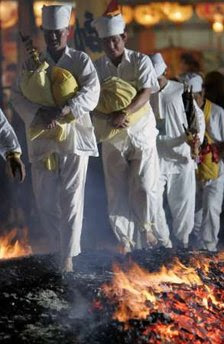
Devotees walk on fire during the festival of the Nine Emperor Gods in Kuala Lumpur. Malaysia.
 Devotees walk on fire during the festival of the Nine Emperor Gods in Kuala Lumpur, Malaysia.

A devotee prepares the firewalking site during the festival of the Nine Emperor Gods in Kuala Lumpur, Malaysia.

Devotees walk on fire during the festival of the Nine Emperor Gods in Kuala Lumpur, Malaysia on the 7th October, 2008. The festival is held annually on the ninth day of the ninth lunar month.
http://en.wikipedia.org/wiki/Nine_Emperor_Gods_Festival
http://www.towbookong.org.my
http://weecheng.com/singapore/9eg/index.htm
 The Dalai Lama has presided over an unprecedented conference of Tibetan exiles in Dharmsala, India.
 HIgh on the agenda at the conference has been how to prepare for the death of the Tibetan spiritual leader.
 The exiles fear that China may exploit the years while the Dalai Lama’s reincarnation is growing up to try to appoint its own rival candidate.
 A plan under hot discussion is whether the Dalai Lama should appoint a regent to take charge straight after his death, such as the charismatic young Karmapa Lama. Onlookers say that the Dalai Lama appears to be grooming the younger lama for this role.
 The 600 delegates also debated whether to drop the Dalai Lama’s push for "meaningful autonomy" from China, replacing it with an unequivocal demand for independence.
  After debate and prayer, the conference decided not to risk Chinese anger by seeking to split away from Tibet’s powerful neighbour.
 Dolma Gyari, deputy speaker of the Tibetan parliament-in-exile,said that delegates reaffirmed support for the Dalai Lama’s approach - but also said it was time to end talks with Beijing.
 In his address to the exiled Tibetans, the Dalai Lama warned that they would need to tread with extreme care and prudence in the next 20 years, as they were in "great danger".
  Many leaders of the exiles believe that the larger Tibetan cause is at a crossroads.
 A lighter moment as the Dalai Lama holds musician Phil Void by his beard in a friendly gesture.


 Construction experts from countries including Britain, Germany, and Italy, come to see the monastery. In their words, Hanging Monastery, which mixes mechanics, aesthetics, and Buddhism, is rare. The monastery and everything it symbolizes embodies a great cultural achievement of Chinese people.


 Posts
Posts


 American Dollar Exchange Rate
![[Most Recent Quotes from www.kitco.com]](https://lh3.googleusercontent.com/blogger_img_proxy/AEn0k_syAV2G3C1dQcGRcyNuGoRaqigFG2PNSrwvOcb-dSNyDSH7hPSRLrDWAvRjKnM7o4ph6i4JD-N24kxIQ9WCkOBAOZsNA4Hxp_tOdKGWrokjblJ_nsg=s0-d)


